Thursday, April 23, 2009

Actinide


ACTINIDE SERIES OF METALS
There are two rows under the table. The Lanthanide and Actinide series. The Lanthanide series can be found naturally on Earth. Only one element in the series is radioactive. The Actinide series is much different. They are all radioactive and some are not found in nature. Some of the elements with higher atomic numbers have only been made in labs. There are special laboratories across the world that specialize in experimenting on elements. Some of these particle accelerators have pounded atomic particles into elements with lower atomic numbers. The buildup of additional parts creates short-lived elements.

MEET THE FAMILY
Fifteen elements that start with actinium (Ac) at atomic number 89 and finishing up with lawrencium (Lr) at number 103. It's doubtful your teachers will ever ask you to remember all of the elements in the series, just remember actinium.

Lanthanide


LANTHANIDE SERIES OF METALS
When you look at the periodic table you will see two rows that kind of sit off to the bottom. One of those rows is called the Lanthanide series. There are a bunch of names that you may hear that describe these 15 elements. Some say Lanthanide, some say rare-earth and some say inner-transition elements. No matter what you choose everyone will know what you mean if you say Lanthanide.

MEET THE FAMILY
Fifteen elements that start with lanthanum (La) at atomic number 57 and finishing up with lutetium (Lu) at number 71. It's doubtful your teachers will ever ask you to remember all of the elements in the series, just remember lanthanum.

Transition Metals


TRANSITIONING

Lets start off by telling you that there are a lot of elements that are considered transition metals. Which metals are the transition metals? 21 (Scandium) through 29 (Copper)39 (Yttrium) through 47 (Silver)57 (Lanthanum) through 79 (Gold)89 (Actinium) and all higher numbers.


WHAT MAKES THEM SO SPECIAL?
It all has to do with their shells/orbitals. In CHEM4KIDS we try to stick to the first 18 elements because they are easy to explain. Transition metals are good examples of advanced shell ideas. They have a lot of electrons and distribute them in different ways.


Transition metals are able to put more than eight electrons in the shell that is one in from the outermost shell. Think about argon (Ar). It has 18 electrons set up in a 2-8-8 order. Scandium is only 3 spots away with 21 electrons, but it has a configuration of 2-8-9-2. Wow! This is where it starts. This is the point in the periodic table where you can place more than 8 electrons in a shell.
The transition metals are able to put up to 32 electrons in their second to last shell. Something like gold (Au) has an organization of 2-8-18-32-18-1. Of course, there are still some rules. No shell can have more than 32 electrons. It's usually 18 or 32 for the maximum number of electrons.

ONE MORE THING
Most elements can only use electrons from their outer orbital to bond with other elements. Transition metals can use the two outermost shells/orbitals to bond with other elements. It's a chemical trait that allows them to bond with many elements in a variety of shapes. Why can they do that?
As you learn more, you will discover that most transition elements actually have two shells that are not happy. Whenever you have a shell that is not happy, its electrons can bond with other elements. Example: Molybdenum (Mo) with 42 electrons. The configuration is 2-8-18-13-1. The shells with 13 and 1 are not happy. Those two orbitals can use the electrons to bond with other atoms.

Alkaline Earth


HEADING TO GROUP TWO

So we just covered the alkali metals in Group I. You will find the alkaline earth metals right next door in Group II. This is the second most reactive family of elements in the periodic table. Did you know why they are called alkaline? When these compounds are mixed in solutions, they are likely to form solutions with a pH greater than 7. Those pH levels are defined as 'basic' or 'alkaline' solutions.


A FAMILY PORTRAIT


Who's in the family? The members of the alkaline earth metals include: beryllium (Be), magnesium (Mg), calcium (Ca), strontium (Sr), barium (Ba) and radium (Ra). As with all families, these elements share traits. While not as reactive as the alkali metals, this family knows how to make bonds very easily. Each of them has two electrons in their outer shells. They are ready to give up those two electrons in electrovalent bonds. Sometimes you will see them with two halogen atoms (BeF2) and sometimes they might form a double bond (CaO). It's all about giving up those electrons to have a full outer shell.

As you get to the bottom of the list, you will find the radioactive radium (Ra). While radium is not found around your house anymore, it used to be used in glow-in-the-dark paints. The other elements are found in many items including fireworks, batteries, flashbulbs, and special alloys. The lighter alkaline earth metals such as magnesium and calcium are very important in animal and plant physiology. You all know that calcium helps build your bones.

Alkali Metals


ALKALI METALS TO THE LEFT

Let's start on the left side of the periodic table. When looking for families, the first one you will find is the alkali metal family of elements. They are also known as the alkaline metals. You should remember that there is a separate group called the alkaline earth metals in Group Two. They are a very different family even though they have a similar name. That far left column is Group One (Group I). When we talk about the groups of the periodic table, scientists use Roman numerals when they write them out.


A FAMILY PORTRAIT

Who's in the family? Starting at the top we find hydrogen (H). But wait. That element is NOT in the family. When we told you about families, we said that they were groups of elements that react in similar ways. Hydrogen is a very special element of the periodic table and doesn't belong to any family. While hydrogen sits in Group I, it is NOT an alkali metal.


FAMILY BONDING

Now that we've covered that exception, the members of the family include: Lithium (Li), Sodium (Na), Potassium (K), Rubidium (Rb), Cesium (Cs) and Francium (Fr). As with all families, these elements share traits. They are very reactive. Why? They all have one electron in their outer shell. That's one electron away from being happy (full shells). When you are that close to having a full shell, you want to bond with other elements and lose that electron. An increased desire to bond means you are more reactive. In fact, when you put some of these pure elements in water, they will cause huge explosions.

The alkali metals are also metals. That seems obvious from the name. Often, in chemistry, characteristics are assigned by the way elements look. You will find that the alkali group is shiny and light in weight. Their light weight and physical properties separate them from other metals. Alkali metals are not the type of metals you would use for coins or houses.

Metals


METAL BASICS

We wanted to give you a big overview of metals before we talk about details in other tutorials. Almost 75% of all elements are classified as metals. They are not all like silver (Ag), gold (Au), or platinum (Pt). Those are the very cool and shiny ones. There are other metals like potassium (K) and iridium (Ir) that you might not think about right away.


MANY KINDS OF METALS

How many kinds of metals are there? So many. Don't even try to memorize them all. Just remember the ones you might need in class. Here's a quick list: Actinide Metals, Lanthanide Metals, Alkali Metals, Alkaline-Earth Metals, Noble Metals, Rare Metals, Rare-Earth Metals, and Transition Metals. Lucky for you the periodic table is excellent at organizing elements, and you will find each of these groups in specific areas of the periodic table.


HOW DO YOU IDENTIFY A METAL?


What are the characteristics of metals? We've got four traits that will help you identify whether an element is a metal or not.

Conduction: Metals are good at conducting electricity. Silver (Ag) and copper (Cu) are some of the most efficient metals and are often used in electronics.

Reactivity: Metals are very reactive, some more than others, but most form compounds with other elements quite easily. Sodium (Na) and potassium (K) are some of the most reactive metals.

Chemical: A little complex here. Metals usually make positive ions when the compounds are dissolved in solution. Also, their metallic oxides make hydroxides (bases) (OH-) and not acids when in solution. Think about this example. Sodium chloride (NaCl), when dissolved in water, breaks apart into sodium (Na+) and chlorine (Cl-). See that sodium is the positive ion? Sodium is the metal. It works that way for other metals. Potassium chlorine (KCl) works the same way.

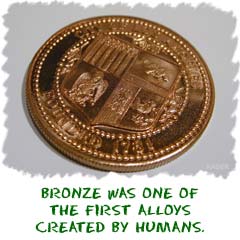
Alloys: Metals are easily combined. Mixtures of many elements are called alloys. Examples of alloys are steel and bronze.

Inert Gases


THE NOBLE INERT GASES

We love the inert gases. Some scientists used to call them the noble gases. These gases are another family of elements, and all of them are located in the far right column of the periodic table. For all of you budding chemists, the far right is also known as Group Zero (Group 0) or Group Eighteen (Group XVIII). This family has the happiest elements of all.


WHY ARE THEY HAPPY?

Using the Bohr description of electron shells, happy atoms have full shells. All of the inert gases have full outer shells with eight electrons. Oh wait! That's not totally correct. At the top of the inert gases is little helium (He) with a shell that is full with two electrons. The fact that their outer shells are full means they are quite happy not reacting with other elements. In fact, they rarely combine with other elements. That nonreactivity is why they are called inert.


WHO'S IN THE FAMILY?


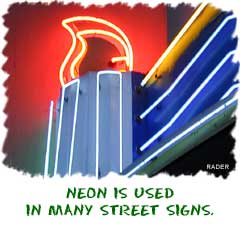
All of the elements in Group Zero are inert gases. The list includes Helium (He), Neon (Ne), Argon (Ar), Krypton (Kr), Xenon (Xe), and Radon (Rn). Don't think that because these elements don't like to react, we don't use them. You will find inert gases all over our world. Neon is used in advertising signs. Argon is used in light bulbs. Helium is used to cool things and in balloons. Xenon is used in headlights for new cars. When you move down the periodic table, as the atomic numbers increase, the elements become rarer. They are not just rare in nature but rare as useful elements, too.


BUT WAIT, THEY DO BOND!

Some do. As of about 40 years ago, scientists have been able to make some compounds with inert gases. Some have been used in compounds to make explosives and other just form compounds in a lab. The thing to remember is that they were forced. When going about their natural lives, you will never (never say never because there may be an exception) find the inert gases bonded with other elements.

Halogens


HALOGENS ON THE RIGHT

In the second column from the right side of the periodic table, you will find Group Seventeen (Group XVII). This column is the home of the halogen family of elements. Who is in this family? The elements included are Fluorine (F), Chlorine (Cl), Bromine (Br), Iodine (I), and Astatine (At).


WHAT MAKES THEM SIMILAR?

When you look at our descriptions of the elements fluorine (F) and chlorine (Cl) you will see that they both have seven electrons in their outer shell. That seven-electron idea applies to all of the halogens. They are all just one electron shy of having full shells. Because they are so close to being happy, they have the trait of combining with many different elements. You will often find them bonding with metals and elements from Group One of the periodic table.


We've just told you how reactive they are. Not all halogens react with the same intensity. Fluorine is actually the most reactive and combines all of the time. As you move down the column, reactivity decreases. As you learn more about the table, you will find this pattern true for other families.

THEN WHAT IS A HALIDE?

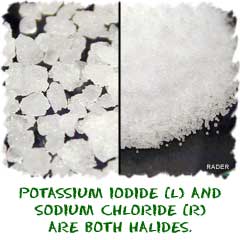
The elements we are talking about in this section are called halogens. When a halogen combines with another element, the resulting compound is called a halide. One of the best examples of a halide is sodium chloride (NaCl). Don't think that the halogens always make ionic compounds. Many halides of the world are made with covalent compounds.

FAMILIES


FAMILIES STICK TOGETHER

We just covered the columns and rows of the periodic table. There are also other, less specific, groups of elements. These groups are all over the table. Scientists group these families of elements by their chemical properties. Each family reacts a different way with the outside world. Metals behave differently than gases and there are even different types of metals. Some don't react, others are very reactive, and some are metallic.

Usually, the columns of the periodic table are used to define families. The inert gases are all located in the far right column of the table. That column is labeled Group Zero. The other possibility that can happen are elements in a series. Good examples of a series of elements in the same family are the transition metals.

The thing to remember is... A family of elements can be found in several ways. You need to run tests and study the elements to determine their properties. Only after that testing, can you determine what family an element belongs in.

EXAMPLES OF FAMILIES

- Alkali Metals- Alkaline Earth Metals- Transition Metals- Halogen Gases- Inert Gases (Noble Gases)


EXAMPLES OF PHYSICAL PROPERTIES

- Density- Boiling Point- Melting Point- Conductivity- Heat Capacity

EXAMPLES OF CHEMICAL PROPERTIES

- Valence- Reactivity- Radioactivity

ELEMENT LIST

We've got 18 to choose from. From the beginning we've been asked, "Why only cover 18?" The rules for the first 18 elements are very straight-forward. (1) Electrons fit nicely into three shells. (2) These elements make up most of the matter in the universe. (3) It's a lot easier to remember facts about 18 elements than over 100 elements.


THE LIST
Element 1: Hydrogen Element 2: Helium Element 3: Lithium Element 4: Beryllium Element 5: Boron Element 6: Carbon Element 7: Nitrogen Element 8: Oxygen Element 9: Fluorine Element 10: Neon Element 11: Sodium Element 12: Magnesium Element 13: Aluminum Element 14: Silicon Element 15: Phosphorus Element 16: Sulfur Element 17: Chlorine Element 18: Argon


MORE THAN 18?
Yes, it's true. After these many years, we have added elements 18-36 to our list of elements. You can learn about element origins, pronunciation, atomic structure, and locations. This next set of elements is from the fourth period/row of the table. Be aware... The easy rules don't apply here. We tried to make things as simple as possible.

Element 19: Potassium Element 20: Calcium Element 21: Scandium Element 22: Titanium Element 23: Vanadium Element 24: Chromium Element 25: Manganese Element 26: Iron Element 27: Cobalt Element 28: Nickel Element 29: Copper Element 30: Zinc Element 31: Gallium Element 32: Germanium Element 33: Arsenic Element 34: Selenium Element 35: Bromine Element 36: Krypton

Elements as Building Blocks

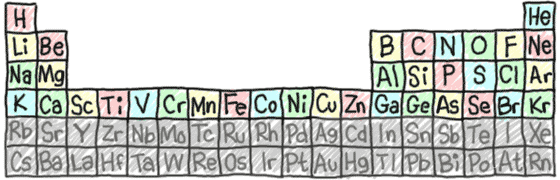
As you probably saw, the periodic table is organized like a big grid. The elements are placed in specific places because of the way they look and act. If you have ever looked at a grid, you know that there are rows (left to right) and columns (up and down). The periodic table has rows and columns, too, and they each mean something different.


You've got Your Periods...

Even though they skip some squares in between, all of the rows go left to right. When you look at a periodic table, each of the rows is considered to be a different period (Get it? Like PERIODic table.). In the periodic table, elements have something in common if they are in the same row. All of the elements in a period have the same number of atomic orbitals. Every element in the top row (the first period) has one orbital for its electrons. All of the elements in the second row (the second period) have two orbitals for their electrons. It goes down the periodic table like that. At this time, the maximum number of electron orbitals or electron shells for any element is seven.

...and Your Groups

Now you know about periods. The periodic table has a special name for its columns, too. When a column goes from top to bottom, it's called a group. The elements in a group have the same number of electrons in their outer orbital. Every element in the first column (group one) has one electron in its outer shell. Every element on the second column (group two) has two electrons in the outer shell. As you keep counting the columns, you'll know how many electrons are in the outer shell. There are some exceptions to the order when you look at the transition elements, but you get the general idea.

Two at the Top

Hydrogen (H) and helium (He) are special elements. Hydrogen can have the talents and electrons of two groups, one and seven. To scientists, hydrogen is sometimes missing an electron, and sometimes it has an extra. Helium is different from all of the other elements. It can only have two electrons in its outer shell. Even though it only has two, it is still grouped with elements that have eight (inert gases).
The elements in the center section are called transition elements. They have special electron rules

The List of Elements

We've got 18 to choose from. From the launch of the site we've been asked, "Why start with 18?" The rules for the first 18 elements are very straight-forward.

(1) Electrons fit nicely into three shells.

(2) These elements make up most of the matter in the universe.

(3) It's a lot easier to remember facts about 18 elements than over 100 elements.

Element 1: Hydrogen Element 2: Helium Element 3: Lithium Element 4: Beryllium Element 5: Boron Element 6: Carbon Element 7: Nitrogen Element 8: Oxygen Element 9: Fluorine Element 10: Neon Element 11: Sodium Element 12: Magnesium Element 13: Aluminum Element 14: Silicon Element 15: Phosphorus Element 16: Sulfur Element 17: Chlorine Element 18: Argon

Who are we kidding? We teased you with only 18 elements for many years. We've added the next 18 elements from the fourth period. You need to remember that this is the first row with transition elements. Those transition metals have electron configurations that are a little different from the first 18. Make sure you understand the first 18 before you move on to this set.

Element 19: Potassium Element 20: Calcium Element 21: Scandium Element 22: Titanium Element 23: Vanadium Element 24: Chromium Element 25: Manganese Element 26: Iron Element 27: Cobalt Element 28: Nickel Element 29: Copper Element 30: Zinc Element 31: Galium Element 32: Germanium Element 33: Arsenic Element 34: Selenium Element 35: Bromine Element 36: Krypton

The Same Everywhere


As far as we know, there are only so many basic elements. Up to this point in time we have discovered/created over 100. While there may be more out there to discover, the basic elements remain the same. Iron (Fe) atoms found on Earth are identical to iron atoms found on meteorites. The iron atoms on Mars that make the soil red are the same too.
The point is... With the tools you learn here, you can explore and understand the universe. You will never stop discovering new reactions and compounds, but the elements will remain the same.

Periodic Table and the Elements


Now we're getting to the heart and soul of the way your universe works. Elements are the building blocks of all matter. We talked about quarks in the atoms section. They are smaller than the atoms of an element, but only when they group with other quarks do they form atoms that have recognizable traits. Some quarks combine to make an oxygen (O) atom. Other quarks can combine to form a nitrogen (N) atom. It's the atoms that are different and unique, even though they are made of the same pieces.


DANGEROUS PARTICLES

Radioactivity occurs when an atomic nucleus breaks down into smaller particles. There are three types of particles: alpha, beta, and gamma. Alpha particles are positively charged, beta particles are negatively charged, and gamma particles have no charge. The particles also have increasing levels of energy, first Alpha, then Beta, and finally Gamma, which is the fastest and most energetic of all the emission particles.


The term half-life describes the time it takes for the amount of radioactivity to go down by one half. Let's say you have some uranium (don't try this at home) and it's radioactive. When your measurements tell you that the level of radioactivity has gone down by one-half, the amount of time is the half-life. Every element has its own unique half-life. The half-life of uranium-235 is 713,000,000 years. The half-life of uranium-238 is 4,500,000,000 years. That is a long time to wait for the radioactivity to decrease.


HARNESSING THE ENERGY


Nuclear energy is the energy released when the nuclei of atoms split or are fused. The nucleus is made up of protons and neutrons. Nuclear forces hold all of the pieces together. Fusion is when two nuclei come together. Fission is when one nucleus is split into two or more parts. Huge amounts of energy are released when either of these reactions occurs. Fusion reactions create much of the energy given off by the Sun. There are even smaller particles that make up the protons and neutrons that physicists are studying every day.


ATOMS FROM THE MIRROR UNIVERSE


Since we are talking a little about atomic and nuclear physics, we wanted to tell you about antimatter. It is not just found in television shows. Scientists have proved that it is real. While a regular atom has positive and neutral pieces (protons/neutrons) in the nucleus and negative pieces in orbiting clouds (electrons), antimatter is just the opposite. Antimatter has a nucleus with a negative charge and little positive pieces in the orbits. Those positively charged pieces are called

WHOLE LOTTA RULES GOING ON

The process is just a set of rules. We're going to show you some of the basics. There are some advanced ways of naming things that we're going to skip right now. Let's start with some basic rules. When you have two different elements, there are usually only two words in the compound name. The first word is the name of the first element. The second word tells you the second element and how many atoms there are in the compound. The second word also ends in IDE. That's the suffix. When you are working with non-metals like oxygen (O) and chlorine (Cl), the prefix (section at the beginning of the word) of the second element changes based on how many atoms there are in the compound. It's like this…


Do you notice anything about the chalkboard? You can see that the prefixes are very similar to the prefixes of geometric shapes. You know what a triangle is. Right? Well the prefix tri- means three. So when you have three chlorine (Cl) atoms, you would name it trichloride.


Look at the other names, too. You may know about a pentagon, a hexagon, or an octagon. The naming system in chemistry works the same way! Let's put these ideas together! Remember, we're only talking about simple compounds with no metal elements. Most simple compounds only have two words in their names. Let's start with Carbon monoxide (CO). You have one carbon (C) atom and one oxygen (O) atom (you can also use the prefix MONO to say one atom). Remember that the second word ends in -ide. So...

(1) Carbon + (1) Oxygen = Carbon monoxide

Now we'll build on that example. What if you have one carbon (C) and two oxygen (O) atoms?

(1) Carbon + (2) Oxygen = Carbon dioxide

One last example and we'll call it quits. Now you have one carbon (C) and four chlorine (Cl) atoms.


(1) Carbon + (4) Chlorine = Carbon tetrachloride

You should be getting the idea now. The compound name can tell you how many atoms are inside. Take a look at some of the examples and see if you understand what is happening in the name.

DIFFERENT BONDS ABOUND

Most compounds are made up of combinations of bonds. If you look at sodium chloride (NaCl), it is held together by one ionic bond. What about magnesium chloride (MgCl2)? One magnesium (Mg) and two chlorine (Cl) atoms. There are two ionic bonds. There's a compound called methane (CH<>4). It is made up of one carbon (C) and four hydrogens (H). There are four bonds and they are all covalent. Those examples are very simple compounds, but most compounds are combinations of ionic and covalent bonds.

Let's look at sodium hydroxide (Na-OH)…

You can see that on the left is the sodium (Na) part and the right has the oxygen/hydrogen (-OH) part. The bond that binds the hydrogen (H) to the oxygen (O) is covalent. The sodium (Na) is bonded to the hydroxide part of the compound with an ionic bond. This is a very good example of how there can be different types of bonds within one compound.

COMPOUND BASICS

Compounds are groups of two or more elements that are bonded together. There are two main types of bonds that hold those atoms together, covalent and electrovalent/ionic bonds. Covalent compounds happen when the atoms share the electrons, and ionic compounds happen when electrons are donated from one atom to another.

We talked about compounds and molecules in the matter tutorials. When we discuss phase changes to matter, physical forces create the changes. When we talk about compounds, bonds are built and broken down by chemical forces. Physical forces (unless you're inside of the Sun or something extreme) cannot break down compounds. Chemical forces are forces caused by other compounds or molecules that act on substances.

There are millions of different compounds around you. Chances are everything you can see is one type of compound or another. When elements join and become compounds, they lose their individual traits. Sodium alone is very reactive. But when sodium and chlorine combine, they form a non-reactive substance called sodium chloride (Salt, NaCl). The compound has none of the traits or the original elements. The new compound is not as reactive as the original elements. It has a new life of its own.

BONDING BASICS

You must first learn why atoms bond together. We use a concept called "Happy Atoms." We figure most atoms want to be happy, just like you. The idea behind Happy Atoms is that atomic shells like to be full. That's it. If you are an atom and you have a shell, you want your shell to be full. Some atoms have too many electrons (one or two extra). These atoms like to give up their electrons. Some atoms are really close to having a full shell. Those atoms go around looking for other atoms who want to give up an electron.

Let's take a look at some examples.

We should start with the atoms with atomic numbers between 1 and 18. There is a 2-8-8 rule for these elements. The first shell is filled with 2 electrons, the second is filled with 8 electrons, and the third is filled with 8. You can see that sodium (Na) and magnesium (Mg) have a couple of extra electrons. They, like all atoms, want to be happy. They have two possibilities. (1) They can try to get eight electrons to fill up their third shell. Or (2) they give up a few electrons and have a filled second shell. For them it's easier to give up a few electrons.

What a coincidence! Many other atoms are interested in gaining a few extra electrons.

Oxygen (O) and fluorine (F) are two good examples. Each of those elements is looking for a couple of electrons to make a filled shell. They have one filled shell with two electrons but their second shell wants to have eight. There are a couple of ways they can get the electrons. (1) They can share electrons, making a covalent bond. Or (2) they can just borrow them, and make an ionic bond (also called electrovalent bond).

So we've got a sodium (Na) atom that has an extra electron. We've also got a fluorine (F) atom that is looking for one.

They wind up working together and both wind up happy! Sodium (Na) gives up its extra electron. The sodium (Na) has a full second shell and the fluorine (F) has a full second shell. Two happy atoms! That's one way things are able to bond together. They can give up or share electrons. The two elements have created an electrovalent bond

NEITHER HERE NOR THERE

Neutrons are the particles on an atom that have a neutral charge. They aren't positive like protons. They aren't negative like electrons. But don't start thinking that they aren't important. Every piece of an atom has huge importance to the way the atom acts and behaves. Neutrons are no exception.

So if an atom has equal numbers of electrons and protons, the charges cancel each other out and the atom has a neutral charge. You could add a thousand neutrons into the mix and the charge will not change. However, if you add a thousand neutrons you will be creating one super-radioactive atom. Neutrons play a major role in the mass and radioactive properties of atoms. You may have just read about isotopes. Isotopes are created when you change the normal number of neutrons in an atom.

You know that neutrons are found in the nucleus of an atom. During radioactive decay, they may be knocked out of there. But under normal conditions, protons and neutrons stick together in the nucleus. Their numbers are able to change the mass of atoms because they weigh about as much as a proton and electron together.
ONE SPECIAL ELEMENT
Did we say that all atoms have neutrons? Ooops. All elements have atoms with neutrons except for one. A normal hydrogen (H) atom does not have any neutrons in its tiny nucleus. That tiny little atom (the tiniest of all) has only one electron and one proton. You can take away the electron and make an ion, but you can't take away any neutrons. That special structure becomes very important when you learn how hydrogen interacts with other elements in the periodic table.

MESSING WITH THE MASS


If you have looked at a periodic table you may have noticed that the atomic mass of an element is rarely an even number. That happens because of the isotopes. If you are an atom with an extra electron, it is no big deal. Electrons don't have much of a mass when compared to a neutron or proton.
Atomic masses are calculated by figuring out how many atoms of each type are out there in the universe. For carbon, there are a lot of C-12, a couple C-13, and a few C-14 atoms. When you average out all of the masses, you get a number that is a little bit higher than 12 (the weight of a C-12 atom). The mass for element is actually 12.011. Since you never really know which C atom you are using in calculations, you should use the mass of an average C atom.

RETURNING TO NORMAL
If we look at the C-14 atom one more time we can see that C-14 does not last forever. There is a point where it loses those extra neutrons and becomes C-12. That loss of the neutrons is called radioactive decay. That decay happens regularly like a clock. For carbon, the decay happens in a couple of thousand years. Some elements take longer and others have a decay that happens over a period of minutes.

NEUTRON MADNESS


We have already learned that ions are atoms that are either missing or have extra electrons. Let's say an atom is missing a neutron or has an extra neutron. That type of atom is called an isotope. An atom is still the same element if it is missing an electron. The same goes for isotopes. They are still the same element. They are just a little different from every other atom of the same element.

here are a lot of carbon atoms in the universe. The normal ones are carbon-12. Those atoms have 6 neutrons. There are a few straggler atoms that don't have 6. Those odd ones may have 7 or even 8 neutrons. As you learn more chemistry, you will probably hear about carbon-14. Carbon-14 actually has 8 neutrons (2 extra). C-14 is considered an isotope of the element carbon.

CHARGE IT!


Electrons are the negatively charged particles of atoms. Together, all of the electrons of an atom create a negative charge that balances the positive charge of the protons in the atomic nucleus. Electrons are extremely small compared to all of the other parts of the atom. The mass of an electron is almost 1,000 times smaller than the mass of a proton.

Electrons are found in clouds that surround the nucleus of an atom. Because electrons move so quickly, it is impossible to see where they are at a specific moment in time. After years of experimentation, scientists discovered specific areas where electrons are likely to be found. These shells change depending on how many electrons an element has. The higher the atomic number, the more shells and electrons an atom will have.
Electrons play a major role in many chemical bonds. There is one type of bonding called electrovalent bonding (ionic) where an ion from one atom is transferred to another atom. It is an even trade, creating two ions. The second type of bonding is called covalent bonding. Electrons are actually shared between two or more atoms in a cloud. Both types have specific advantages and weaknesses.

POWER UP
Electrons are very important in the world of electronics. The very small particles stream through wires and circuits creating currents of electricity. The electrons move from negatively charged parts to positively charged ones. The negatively charged pieces of any circuit have extra electrons while the positively charged pieces want more electrons. The electrons then jump from one area to another. When the electrons move, the current can flow through the system.

ELECTROVALENCE


Don't get worried about the big word. Electrovalence is just another word for something that has given up its electron and become an ion. If you look at the periodic table, you might notice that elements on the left side usually become positively charged ions and elements on the right side get a negative charge. That trend means the left side has a positive valence and the right side has a negative valence. Valence is a measure of how much an atom wants to bond with other atoms.


There are two main types of bonding, covalent and electrovalent. Scientists also call ionic bonds electrovalent bonds. Ionic bonds are just groups of charged ions held together by electric forces. Scientists call these groups ionic agglomerates. When in the presence of other ions, the electrovalent bonds are weaker because of outside electrical forces and attractions.

Look at sodium chloride (table salt) as an example. Salt is a very strong bond when it is sitting on your table. It would be nearly impossible to break those ionic bonds. However, if you put that salt into some water the bonds break very quickly. It happens easily because of the electrical attraction of the water. Now you have sodium (Na+) and chloride (Cl-) ions. Remember that ionic bonds are normally strong but very weak in water.

ION CHARACTERISTICS


So now you've become a sodium ion (Na+). Now you have ten electrons. That's the same number as neon (Ne). But you aren't neon (Ne). Since you're missing an electron you aren't really a complete sodium (Na) atom either. You are now something completely new. An ion. Your whole goal as an atom was to become a "happy atom" with completely filled electron orbitals. Now you have those filled shells. You are stable. What do you do that's so special now? Now that you have given up the electron, you are quite electrically attractive. Other electrically charged atoms (ions) are now looking at you and seeing a good partner to bond with. That's where chlorine comes in.

LOOKING AT IONS

We've talked about ions before. Now it's time to get down to basics. Ions are atoms with either extra electrons or missing electrons. A normal atom is called a neutral atom. That term describes an atom with a number of electrons equal to the atomic number.

What do you do if you are a sodium (Na) atom? You have eleven electrons, one too many to have your shell filled. You need to find another element who will take that electron away from you. Bring in chlorine (Cl). Chlorine (Cl) will take that electron away and leave you with 10 electrons inside of two filled shells. You are a happy atom. Now you are also an ion and missing one electron. You are a sodium ion (Na+). You have one less electron than your atomic number.

ORBITAL BASICS

As you know, electrons are always moving. They spin very quickly around the nucleus of an atom. As the electrons spin, they can move in any direction, as long as they stay in their shell. Any direction you can imagine - upwards, downwards, or sidewards - electrons can do it. The atomic shell or orbital is the distance from the nucleus that the electron spins. If you are an electron in the first shell you are always closer to the nucleus than the electrons in the second shell.

Let's cover some basics of atomic orbitals.

1. A shell is sometimes called an orbital or energy level.

2. Shells are areas that surround the center of an atom.

3. The center of the atom is called the nucleus.

4. Electrons live in something called shells.

5. Each of those shells has a name.

There are a couple of ways that atomic orbitals are named. You may have heard of the SPDF system before. Chemists also use letters to name the orbitals around a nucleus. They use the letters "k,l,m,n,o,p, and q". The "k" shell is the one closest to the nucleus and "q" is the farthest away.


Not all shells hold the same number of electrons. For the first eighteen elements, there are some easy rules. The k-shell only holds two electrons. The l-shell only holds eight electrons. The m-shell only holds eight electrons (for the first eighteen elements). The m-shell can actually hold up to 18 electrons as you move farther along the periodic table. The maximum number of electrons you will find in any shell is 32.

WHERE ARE THE ELECTRONS?

We've been telling you that electrons reside in specific shells or move in specific directions. We can't really tell you exactly where an electron is at any moment in time. We can only approximate, or guess, where an electron is located. According to something called quantum theory, an electron can be found anywhere around the nucleus. Using advanced math, scientists are able to approximate, or guess, that electrons are in general areas. These general areas are called the shells.

SMALLER THAN ATOMS?

Are there pieces of matter that are smaller than atoms? Sure there are. You'll soon be learning that atoms are composed of pieces like neutrons, electrons, and protons. But guess what? There are even smaller particles moving around in atoms. These super-small particles can be found inside the protons and neutrons. Scientists have many names for those pieces, but you may have heard of nucleons and quarks. Nuclear chemists and physicists work together with particle accelerators to discover the presence of these tiny, tiny, tiny pieces of matter.

Even though those super tiny atomic particles exist, there are three basic parts of an atom. The parts are the electrons, protons, and neutrons. What are electrons, protons, and neutrons? A picture works best. You have a basic atom. There are three pieces to an atom. There are electrons, protons, and neutrons. That's all you have to remember. Three things! As you know, there are over 100 elements in the periodic table. The thing that makes each of those elements different is the number of electrons, protons, and neutrons. The protons and neutrons are always in the center of the atom. Scientists call the center of the atom the nucleus. The electrons are always found whizzing around the center in areas called orbitals.

You can also see that each piece has either a "+", "-", or a "0." That symbol refers to the charge of the particle. You know when you get a shock from a socket, static electricity, or lightning? Those are all different types of electric charges. There are even charges in tiny particles of matter like atoms. The electron always has a "-" or negative charge. The proton always has a "+" or positive charge. If the charge of an entire atom is "0", that means there are equal numbers of positive and negative pieces, equal numbers of electrons and protons. The third particle is the neutron. It has a neutral charge (a charge of zero).

ATOMS = BUILDING BLOCKS


Atoms are the basis of chemistry. They are the basis for everything in the Universe. You should start by remembering that matter is composed of atoms. Atoms and the study of atoms are a world unto themselves. We're going to cover basics like atomic structure and bonding between atoms. As you learn more, you can move to the biochemistry tutorials and see how atoms form compounds that help the biological world survive.

Atoms Around Us

If you want to have a language, you will need an alphabet. If you want to build proteins, you will need amino acids. Other examples in chemistry are not any different. If you want to build molecules, you will need elements. Each element is a little bit different from the rest. Those elements are the alphabet to the language of molecules.


Why are we talking about elements? This is the section on atoms.


Let's stretch the idea a bit. If you read a book, you will read a language. Letters make up that language. But what makes those letters possible? Ummm... Ink? Yes! You need ink to crate the letters. And for each letter, it is the same type of ink.

Confused? Don't be. Elements are like those letters. They have something in common. That's where atoms come in. All elements are made of atoms. While the atoms may have different weights and organization, they are all built in the same way. Electrons, protons, and neutrons make the universe go.

If you want to do a little more thinking, start with particles of matter. Matter, the stuff around us, is used to create atoms. Atoms are used to create the elements. Elements are used to create molecules. It just goes on. Everything you see is built by using something else.

You could start really small...
- Particles of matter
- Atoms
- Elements
- Molecules
- Macromolecules
- Cell organelles
- Cells
- Tissues
- Organs
- Systems
- Organisms
- Populations
- Ecosystems
- Biospheres
- Planets
- Planetary Systems with Stars
- Galaxies
- The Universe
…And finish really big.

Wow. All of that is possible because of atoms.

PUTTING TOGETHER AND BREAKING APART


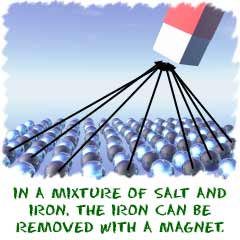
The thing to remember about mixtures is that you start with some pieces, combine them, and then you can do something to pull those pieces apart again. You wind up with the same molecules (in the same amounts) that you started with. The way you separate the molecules is as unique as the mixture. We have talked about grinding and boiling. If you have a mixture of salt and tiny pieces of iron, you could use a magnet to separate the iron from the mixture.

MIXTURES AROUND YOU


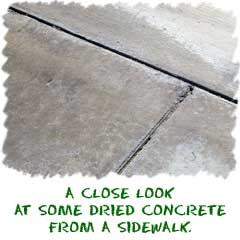
Two classic examples of mixtures are concrete and salt water. If you live near the ocean, they surround you every day. Even if you're inland, you need to remember your tap water also has many compounds inside, and they act the same way salt would. That is, concrete is a mixture of lime (CaO)/cement, water, sand, and other ground-up rocks and solids. All of these ingredients are mixed together. Workers then pour the concrete into a mold and the concrete turns into a solid (because of the cement solidifying) with the separate pieces inside.
While the cement hardening might be a chemical reaction, the rocks and gravel are held in place by physical forces. They are included in the mixture to increase the strength of concrete. The rocks and gravel are not chemically bonded to the cement. The gravel is also not evenly distributed. There are pieces of gravel here and there. The concentrations of gravel change from area to area. Salt water is different. First, it's a liquid. Second, it's an ionic solution. The salt is broken up into sodium (Na) and chloride (Cl) ions in the water.
You might be wondering why concrete and salt water are not new compounds when they are mixed together. The special trait of mixtures is that physical forces can still remove the basic parts. You can take the solid concrete and grind it up again. The individual components can then be separated and you can start all over. Salt water is even easier. All you have to do is boil the water off and the salt is left, just as if you never mixed the two compoun

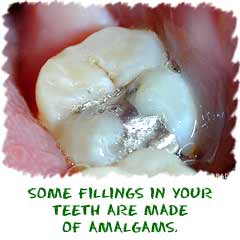
AMALGAMS

Amalgams are a special type of alloy. We like them because we think mercury (Hg) is a cool element. You might know mercury as "quicksilver" or the metal that is liquid at room temperature. Anyway, amalgams are alloys that combine mercury and other metals in the periodic table. The most obvious place you may have seen amalgams is in old dental work. The fillings in the mouths of your grandparents may have been amalgams. We already talked about mercury's being a liquid at room temperature. That physical trait was used when they made fillings. Let's say you have an amalgam of mercury (Hg) and silver (Ag). When it is created, it is very soft. As time passes, the mercury leaves the amalgam and the silver remains. The silver that is left is very hard. Voila! You have a filling!

NOTE: Never, ever, play with mercury (Hg)! It is very poisonous. You shouldn't even touch it because it will seep into your skin. Dentists don't usually use amalgams with mercury anymore because it may have slowly poisoned people and gotten them sick.
EMULSIONS
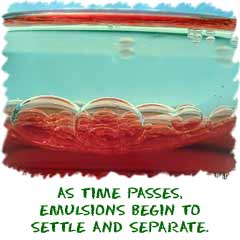
Let's finish up with a little information on emulsions. These special colloids (another type of mixture) have a mixture of oils and waters. Think about a bottle of salad dressing. Before you mix it, there are two separate layers of liquids. When you shake the bottle, you create an emulsion. As time passes, the oil and water will separate to their original states.

ALLOYS


There are a few more words you might hear when people talk about mixtures. We can't cover all of them, but we'll give you a quick overview of the biggies. Alloys are basically a mixture of two or more metals. Don't forget that there are many elements on the periodic table. Elements like calcium (Ca) and potassium (K) are considered metals. Of course, there are also metals like silver (Ag) and gold (Au). You can also have alloys that include small amounts of non-metallic elements like carbon (C). Metals are the key thing to remember for alloys.
The main idea with alloys is that they are better at something than any of the metals would be alone. Metallurgists (people who work with metals) sometimes add chromium (Cr) and/or nickel (Ni) to steel. While steel is already an alloy that is a very strong metal, the addition of small amounts of the other metals help steel resist rusting. Depending on what element is added, you could create Stainless Steel or Galvanized Steel. It's always about improving specific qualities of the original. Another good example of an alloy happens when metallurgists add carbon (C) to steel. A tiny amount of carbon (a non-metallic element) make steel stronger. These special carbon-steel alloys are used in armor plating and weapons.

MIXTURES ARE EVERYWHERE


There are an infinite number of mixtures. Anything you can combine is a mixture. Think of everything you eat. Just think about how many cakes there are. Each of those cakes is made up of a different mixture of ingredients. Even the wood in your pencil is considered a chemical mixture. There is the basic cellulose of the wood, but there are also thousands of other compounds in that pencil
Solutions are also mixtures. If you put sand into a glass of water, it is considered to be a mixture. You can always tell a mixture because each of the substances can be separated from the group in different physical ways. You can always get the sand out of the water by filtering the water away. A solution can also be made of two liquids. Even something as simple as bleach and water is a solution.

MIXTURE BASICS

Mixtures are absolutely everywhere you look. Mixtures are the form for most things in nature. Rocks, air, or the ocean, they are just about anything you find. They are substances held together by physical forces, not chemical. That statement means the individual molecules enjoy being near each other, but their fundamental chemical structure does not change when they enter the mixture.

When you see distilled water, it's a pure substance. That fact means that there are just water molecules in the liquid. A mixture would be a glass of water with other things dissolved inside, maybe salt. Each of the substances in that glass of water keeps the original chemical properties. So, if you have some dissolved substances, you can boil off the water and still have those dissolved substances left over. Because it takes very high temperatures to boil salt, the salt is left in the container.


CAN ANYTHING CHANGE SOLUTIONS?

Sure. All sorts of things can change the concentrations of substances in solution. Scientists use the word solubility. Solubility is the ability of the solvent (water) to dissolve the solute (sugar). You may have already seen the effect of temperature in your classes. Usually when you heat up a solvent, it can dissolve more solid materials (sugar) and less gas (carbon dioxide). Next on the list of factors is pressure. When you increase the surrounding pressure, you can usually dissolve more gases in the liquid. Think about your soda can. They are able to keep the fizz inside because the contents of the can are under higher pressure. Last is the structure of the substances. Some things dissolve easier in one kind of substance than another. Sugar dissolves easily in water; oil does not. Water has a low solubility when it comes to oil.

MAKING SOLUTIONS

So what happens? How do you make that solution? Mix the two liquids and stir. It's that simple. Science breaks it into three steps. When you read the steps, remember... Solute=Sugar, Solvent=Water, System=Glass.

1. The solute is placed in the solvent and the concentrated solute slowly breaks into pieces. 2. The molecules of the solvent begin to move out of the way and they make room for the molecules of the solute. Example: The water has to make room for the sugar molecules. 3. The solute and solvent interact with each other until the concentration of the two substances is equal throughout the system. The concentration of sugar in the water would be the same from a sample at the top, bottom, or middle of the glass.