ACTINIDE SERIES OF METALS
MEET THE FAMILY
We wanted to give you a big overview of metals before we talk about details in other tutorials. Almost 75% of all elements are classified as metals. They are not all like silver (Ag), gold (Au), or platinum (Pt). Those are the very cool and shiny ones. There are other metals like potassium (K) and iridium (Ir) that you might not think about right away.
MANY KINDS OF METALS
How many kinds of metals are there? So many. Don't even try to memorize them all. Just remember the ones you might need in class. Here's a quick list: Actinide Metals, Lanthanide Metals, Alkali Metals, Alkaline-Earth Metals, Noble Metals, Rare Metals, Rare-Earth Metals, and Transition Metals. Lucky for you the periodic table is excellent at organizing elements, and you will find each of these groups in specific areas of the periodic table.
HOW DO YOU IDENTIFY A METAL?
What are the characteristics of metals? We've got four traits that will help you identify whether an element is a metal or not.
Conduction: Metals are good at conducting electricity. Silver (Ag) and copper (Cu) are some of the most efficient metals and are often used in electronics.
Reactivity: Metals are very reactive, some more than others, but most form compounds with other elements quite easily. Sodium (Na) and potassium (K) are some of the most reactive metals.
Chemical: A little complex here. Metals usually make positive ions when the compounds are dissolved in solution. Also, their metallic oxides make hydroxides (bases) (OH-) and not acids when in solution. Think about this example. Sodium chloride (NaCl), when dissolved in water, breaks apart into sodium (Na+) and chlorine (Cl-). See that sodium is the positive ion? Sodium is the metal. It works that way for other metals. Potassium chlorine (KCl) works the same way.
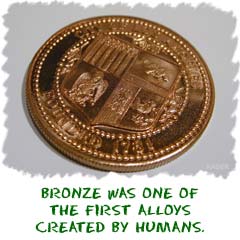
Alloys: Metals are easily combined. Mixtures of many elements are called alloys. Examples of alloys are steel and bronze.
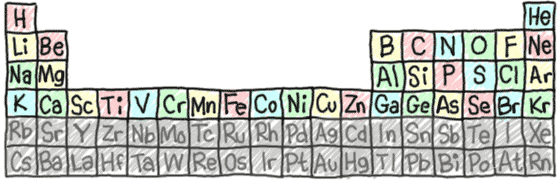
We love the inert gases. Some scientists used to call them the noble gases. These gases are another family of elements, and all of them are located in the far right column of the periodic table. For all of you budding chemists, the far right is also known as Group Zero (Group 0) or Group Eighteen (Group XVIII). This family has the happiest elements of all.
WHY ARE THEY HAPPY?
Using the Bohr description of electron shells, happy atoms have full shells. All of the inert gases have full outer shells with eight electrons. Oh wait! That's not totally correct. At the top of the inert gases is little helium (He) with a shell that is full with two electrons. The fact that their outer shells are full means they are quite happy not reacting with other elements. In fact, they rarely combine with other elements. That nonreactivity is why they are called inert.
WHO'S IN THE FAMILY?
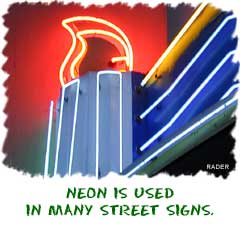
All of the elements in Group Zero are inert gases. The list includes Helium (He), Neon (Ne), Argon (Ar), Krypton (Kr), Xenon (Xe), and Radon (Rn). Don't think that because these elements don't like to react, we don't use them. You will find inert gases all over our world. Neon is used in advertising signs. Argon is used in light bulbs. Helium is used to cool things and in balloons. Xenon is used in headlights for new cars. When you move down the periodic table, as the atomic numbers increase, the elements become rarer. They are not just rare in nature but rare as useful elements, too.
BUT WAIT, THEY DO BOND!
Some do. As of about 40 years ago, scientists have been able to make some compounds with inert gases. Some have been used in compounds to make explosives and other just form compounds in a lab. The thing to remember is that they were forced. When going about their natural lives, you will never (never say never because there may be an exception) find the inert gases bonded with other elements.
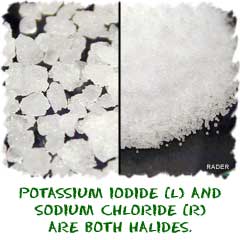
In the second column from the right side of the periodic table, you will find Group Seventeen (Group XVII). This column is the home of the halogen family of elements. Who is in this family? The elements included are Fluorine (F), Chlorine (Cl), Bromine (Br), Iodine (I), and Astatine (At).
WHAT MAKES THEM SIMILAR?
When you look at our descriptions of the elements fluorine (F) and chlorine (Cl) you will see that they both have seven electrons in their outer shell. That seven-electron idea applies to all of the halogens. They are all just one electron shy of having full shells. Because they are so close to being happy, they have the trait of combining with many different elements. You will often find them bonding with metals and elements from Group One of the periodic table.
We've got 18 to choose from. From the launch of the site we've been asked, "Why start with 18?" The rules for the first 18 elements are very straight-forward.
(1) Electrons fit nicely into three shells.
(2) These elements make up most of the matter in the universe.
(3) It's a lot easier to remember facts about 18 elements than over 100 elements.
Element 1: Hydrogen Element 2: Helium Element 3: Lithium Element 4: Beryllium Element 5: Boron Element 6: Carbon Element 7: Nitrogen Element 8: Oxygen Element 9: Fluorine Element 10: Neon Element 11: Sodium Element 12: Magnesium Element 13: Aluminum Element 14: Silicon Element 15: Phosphorus Element 16: Sulfur Element 17: Chlorine Element 18: Argon
Who are we kidding? We teased you with only 18 elements for many years. We've added the next 18 elements from the fourth period. You need to remember that this is the first row with transition elements. Those transition metals have electron configurations that are a little different from the first 18. Make sure you understand the first 18 before you move on to this set.
Element 19: Potassium Element 20: Calcium Element 21: Scandium Element 22: Titanium Element 23: Vanadium Element 24: Chromium Element 25: Manganese Element 26: Iron Element 27: Cobalt Element 28: Nickel Element 29: Copper Element 30: Zinc Element 31: Galium Element 32: Germanium Element 33: Arsenic Element 34: Selenium Element 35: Bromine Element 36: Krypton
The term half-life describes the time it takes for the amount of radioactivity to go down by one half. Let's say you have some uranium (don't try this at home) and it's radioactive. When your measurements tell you that the level of radioactivity has gone down by one-half, the amount of time is the half-life. Every element has its own unique half-life. The half-life of uranium-235 is 713,000,000 years. The half-life of uranium-238 is 4,500,000,000 years. That is a long time to wait for the radioactivity to decrease.
HARNESSING THE ENERGY
Nuclear energy is the energy released when the nuclei of atoms split or are fused. The nucleus is made up of protons and neutrons. Nuclear forces hold all of the pieces together. Fusion is when two nuclei come together. Fission is when one nucleus is split into two or more parts. Huge amounts of energy are released when either of these reactions occurs. Fusion reactions create much of the energy given off by the Sun. There are even smaller particles that make up the protons and neutrons that physicists are studying every day.
ATOMS FROM THE MIRROR UNIVERSE
Since we are talking a little about atomic and nuclear physics, we wanted to tell you about antimatter. It is not just found in television shows. Scientists have proved that it is real. While a regular atom has positive and neutral pieces (protons/neutrons) in the nucleus and negative pieces in orbiting clouds (electrons), antimatter is just the opposite. Antimatter has a nucleus with a negative charge and little positive pieces in the orbits. Those positively charged pieces are called
Do you notice anything about the chalkboard? You can see that the prefixes are very similar to the prefixes of geometric shapes. You know what a triangle is. Right? Well the prefix tri- means three. So when you have three chlorine (Cl) atoms, you would name it trichloride.
Look at the other names, too. You may know about a pentagon, a hexagon, or an octagon. The naming system in chemistry works the same way! Let's put these ideas together! Remember, we're only talking about simple compounds with no metal elements. Most simple compounds only have two words in their names. Let's start with Carbon monoxide (CO). You have one carbon (C) atom and one oxygen (O) atom (you can also use the prefix MONO to say one atom). Remember that the second word ends in -ide. So...
(1) Carbon + (1) Oxygen = Carbon monoxide
Now we'll build on that example. What if you have one carbon (C) and two oxygen (O) atoms?
(1) Carbon + (2) Oxygen = Carbon dioxide
One last example and we'll call it quits. Now you have one carbon (C) and four chlorine (Cl) atoms.
(1) Carbon + (4) Chlorine = Carbon tetrachloride
You should be getting the idea now. The compound name can tell you how many atoms are inside. Take a look at some of the examples and see if you understand what is happening in the name.
We talked about compounds and molecules in the matter tutorials. When we discuss phase changes to matter, physical forces create the changes. When we talk about compounds, bonds are built and broken down by chemical forces. Physical forces (unless you're inside of the Sun or something extreme) cannot break down compounds. Chemical forces are forces caused by other compounds or molecules that act on substances.
There are millions of different compounds around you. Chances are everything you can see is one type of compound or another. When elements join and become compounds, they lose their individual traits. Sodium alone is very reactive. But when sodium and chlorine combine, they form a non-reactive substance called sodium chloride (Salt, NaCl). The compound has none of the traits or the original elements. The new compound is not as reactive as the original elements. It has a new life of its own.
Let's take a look at some examples.
We should start with the atoms with atomic numbers between 1 and 18. There is a 2-8-8 rule for these elements. The first shell is filled with 2 electrons, the second is filled with 8 electrons, and the third is filled with 8. You can see that sodium (Na) and magnesium (Mg) have a couple of extra electrons. They, like all atoms, want to be happy. They have two possibilities. (1) They can try to get eight electrons to fill up their third shell. Or (2) they give up a few electrons and have a filled second shell. For them it's easier to give up a few electrons.
What a coincidence! Many other atoms are interested in gaining a few extra electrons.
Oxygen (O) and fluorine (F) are two good examples. Each of those elements is looking for a couple of electrons to make a filled shell. They have one filled shell with two electrons but their second shell wants to have eight. There are a couple of ways they can get the electrons. (1) They can share electrons, making a covalent bond. Or (2) they can just borrow them, and make an ionic bond (also called electrovalent bond).
So we've got a sodium (Na) atom that has an extra electron. We've also got a fluorine (F) atom that is looking for one.
There are two main types of bonding, covalent and electrovalent. Scientists also call ionic bonds electrovalent bonds. Ionic bonds are just groups of charged ions held together by electric forces. Scientists call these groups ionic agglomerates. When in the presence of other ions, the electrovalent bonds are weaker because of outside electrical forces and attractions.
Let's cover some basics of atomic orbitals.
1. A shell is sometimes called an orbital or energy level.
2. Shells are areas that surround the center of an atom.
3. The center of the atom is called the nucleus.
4. Electrons live in something called shells.
5. Each of those shells has a name.
There are a couple of ways that atomic orbitals are named. You may have heard of the SPDF system before. Chemists also use letters to name the orbitals around a nucleus. They use the letters "k,l,m,n,o,p, and q". The "k" shell is the one closest to the nucleus and "q" is the farthest away.
Not all shells hold the same number of electrons. For the first eighteen elements, there are some easy rules. The k-shell only holds two electrons. The l-shell only holds eight electrons. The m-shell only holds eight electrons (for the first eighteen elements). The m-shell can actually hold up to 18 electrons as you move farther along the periodic table. The maximum number of electrons you will find in any shell is 32.
WHERE ARE THE ELECTRONS?
We've been telling you that electrons reside in specific shells or move in specific directions. We can't really tell you exactly where an electron is at any moment in time. We can only approximate, or guess, where an electron is located. According to something called quantum theory, an electron can be found anywhere around the nucleus. Using advanced math, scientists are able to approximate, or guess, that electrons are in general areas. These general areas are called the shells.
Even though those super tiny atomic particles exist, there are three basic parts of an atom. The parts are the electrons, protons, and neutrons. What are electrons, protons, and neutrons? A picture works best. You have a basic atom. There are three pieces to an atom. There are electrons, protons, and neutrons. That's all you have to remember. Three things! As you know, there are over 100 elements in the periodic table. The thing that makes each of those elements different is the number of electrons, protons, and neutrons. The protons and neutrons are always in the center of the atom. Scientists call the center of the atom the nucleus. The electrons are always found whizzing around the center in areas called orbitals.
You can also see that each piece has either a "+", "-", or a "0." That symbol refers to the charge of the particle. You know when you get a shock from a socket, static electricity, or lightning? Those are all different types of electric charges. There are even charges in tiny particles of matter like atoms. The electron always has a "-" or negative charge. The proton always has a "+" or positive charge. If the charge of an entire atom is "0", that means there are equal numbers of positive and negative pieces, equal numbers of electrons and protons. The third particle is the neutron. It has a neutral charge (a charge of zero).